

The 3-faan minimum changes everything
In Hong Kong rules a hand needs at least 3 faan to win (三番起糊). A complete hand worth 2 can't be declared, so the first question after the deal is "where will my 3 faan come from?" Count them before you commit to a plan, and again every time you claim a tile.
| Faan source | Faan | Note |
|---|---|---|
| Dragon pong (中 發 白) | 1 each | Pong a dragon pair when it's discarded. |
| Seat wind / round wind pong | 1 each | East in the East round is both: 2 faan. |
| No bonus tiles (無花) | 1 | Gone once you draw a flower or season. |
| Seat flower or season (正花) | 1 each | East 1, South 2, West 3, North 4. |
| Concealed hand (門前清) | 1 | Lost the moment you claim a tile. |
| Self-draw (自摸) | 1 | Can't be planned, only hoped for. |
| All chows (平糊) | 1 | Four chows, a plain pair, a two-sided wait. |
| All pongs (對對糊) | 3 | Pairs can be ponged from anyone. |
| Half flush (混一色) | 3 | One suit plus honours. |
| Little three dragons (小三元) | 5 | Two dragon pongs and a pair of the third. |
| Full flush (清一色) | 7 | One suit, no honours. |
Typical 3-faan hands: a dragon pong + Concealed hand + No bonus tiles; a half flush or all pongs on its own; or the chicken hand (雞糊), Concealed hand + Self-draw + No bonus tiles, which must be self-drawn.
The trap: a hand of chows with no faan
A hand of chows and a plain pair looks fast, but it's worth little: All chows 1 (on a two-sided wait), Concealed hand 1 and No bonus tiles 1. That's 3 on a discard only if all three hold.



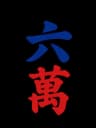
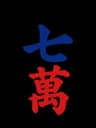

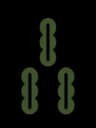
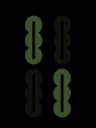
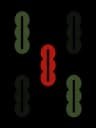
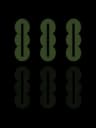
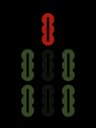
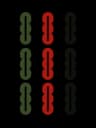

Kept concealed, this hand is 3 faan on anyone's discard (All chows + Concealed hand + No bonus tiles), 4 by self-draw. Now suppose you had chowed the 2-3-4 of Dots. Same tiles, but the engine finds every one of those 11 winning tiles worth only 2 faan on a discard: the hand can only win by self-draw. Go for the 8 of Bamboo instead (throwing the 3 or 6 of Bamboo) and it's a middle wait, so All chows goes too: at most 2 faan, a hand that can never win. Sifu calls it a dead wait. A flower that isn't yours does the same damage as a chow.
Choosing a direction after the deal
After the deal, decide roughly which kind of hand you're playing:
- Speed: a hand that reaches 3 faan with little help, such as one dragon or wind pong plus Concealed hand and No bonus tiles. Aim to be ready early and win first.
- Value: slower but worth much more: a half flush (3), all pongs (3), little three dragons (5) or a full flush (7). In the standard half-spicy table, 7 faan pays six times what 3 faan does.
Most hands start as speed hands with a value option kept open. Switch when the tiles tell you to.
When to go for a flush
Count the tiles in your strongest suit plus your honours: everything else will have to go. Mahjong House's AI counts the tiles outside its main suit and stops planning a half flush at five or more. For a full flush it counts off-suit tiles and honours together and gives up at four. Chase a full flush when it's nearly there, not as a wish.
When to go for all pongs
Pairs are the raw material of all pongs (對對糊), and any player's discard can pong them. Five pairs, or a pong and three pairs, make it realistic; that's where the AI starts planning it too. It combines well with dragon pongs and a half flush.
Honours: keep early or throw early?
Value honours (the dragons, your seat wind and the round wind) are a faan as a pong: keep a pair, and hold even a single one for a turn or two. Other winds are worth nothing to you. Throw a lone one early, while it's safe: late in the hand an honour nobody has discarded is one of the most dangerous tiles to throw (see reading danger).
Tile efficiency: steps from ready and useful tiles
Two numbers measure a hand's shape. Sifu explains its discards in these terms, and the daily puzzle is built around them:
- Steps from ready (向聽): how many more useful draws you need before you're ready (聽牌, one tile from winning). 0 means ready.
- Useful tiles (入章): how many unseen tiles would take you a step closer, counted by copies: holding 4-5 of Dots, the 3s and 6s of Dots are useful, up to 8 tiles, minus any copies you can see.
A good discard keeps the fewest steps first, and the most useful tiles second. The shape of each partial set decides how many tiles help it:



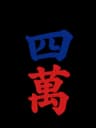

Example 1: which lone tile goes first?
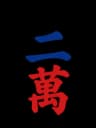





| Discard | Steps from ready | Useful tiles |
|---|---|---|
| South or North Wind | 2 | 40 |
| 1 of Bamboo or 9 of Characters | 2 | 32 |
| 8 of Dots | 2 | 28 |
| Any tile from a finished chow | 3 | - |
Every lone tile leaves you 2 steps from ready, but not equally. A lone wind that isn't yours can only help by pairing; a lone terminal (1 or 9) can grow on one side; a lone middle tile like the 8 of Dots can become 6-8, 7-8 or 8-9. So throw lone non-value honours first, then terminals, and keep middle tiles longest. Breaking a finished set costs a whole step.
Example 2: one shape too many
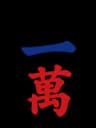


| Discard | Breaks | Steps from ready | Useful tiles |
|---|---|---|---|
| 1 or 2 of Characters | the edge 1-2 | 1 | 11 (5 Dots, 4 and 7 Bamboo) |
| 4 or 6 of Dots | the middle 4-6 | 1 | 11 (3 Characters, 4 and 7 Bamboo) |
| 5, 6 or 8 of Bamboo | the two-sided 5-6 | 1 | 8 (3 Characters, 5 Dots) |
| Anything else | a set or the pair | 2 | - |
One partial set has to go. Break a shape that waits on a single tile (edge or middle), not the two-sided one: that keeps 11 useful tiles instead of 8, and the two-sided shape makes the better wait once you're ready.
Example 3: ready, but can it win?
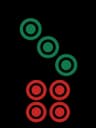

| Discard | Result | Winning tiles left |
|---|---|---|
| 9 of Bamboo | Ready on the 2, 5 and 8 of Bamboo | 11 (you hold a 5) |
| 3 or 6 of Bamboo | Ready on the 8 of Bamboo only | 4 |
| Anything else | 1 step from ready | - |
The 9 of Bamboo is the shape play, but count the faan: a pair of Red Dragons rules out All chows, so on a discard the hand is only Concealed hand + No bonus tiles, 2 faan. Every one of those 11 tiles wins only by self-draw (3 faan). Sifu still takes it, as 11 tiles to draw is the best on offer. But if a flower or season that isn't yours turns up first, the hand can't win at all. That's the 3-faan minimum at work.
Claiming: when to pong, chow or pass
A claim saves a draw, but it exposes a set: you lose Concealed hand (1 faan) and show the table what you're collecting. So it has to buy something.
- Pong a value honour. A dragon, your seat wind or the round wind is 1 faan for nothing. Sifu takes these every time, unless the hand is concealed, already ready and worth at least a faan more than the minimum: then the concealed hand is worth more.
- Pong other tiles when it takes you a step closer and the hand still reaches 3 faan afterwards.
- Chow (上) only from the player before you (上家, on your left). It's the weakest claim: no faan, and Concealed hand is gone. Chow when it takes you a step closer and your 3 faan are already safe, such as a half flush in that suit or a dragon pong down. Sifu never chows into an all-pongs plan, never chows an off-suit tile while a flush is on, and never chows once the hand is ready.
- Kong for the free replacement draw, but don't add a kong (加槓) when someone looks ready: it can be robbed (搶槓), and you'd pay as the discarder. In the last 10 tiles of the wall Sifu stops claiming kongs.
Remember the chow example above: one claim turned a hand that wins on any discard into one that wins only by self-draw. Ask what a claim does to your faan, not just your steps.
Choosing your wait
Once you're ready, what matters is winning tiles left: copies of your waits not in your hand, the discards or anyone's exposed sets.
- More tiles beats fewer. Two-sided: up to 8. Edge, middle or single: 4 at most.
- Tiles people will throw beat tiles they'll hold. A tile that looks safe, like an honour already thrown once, gets discarded more often than a live middle tile.
- Improve the wait when you can. Ready on a middle 4-6 of Dots (one tile, the 5)? Draw a 7 of Dots and throw the 4: now 6-7 waits on 5 or 8, up to twice the tiles.
- Faan first. A wide wait that only wins by self-draw can be worse than a narrow one that wins on any discard.
Single waits (單吊) for all pongs
An all-pongs hand ends up waiting on two pairs (2 + 2 tiles at most) or on a single tile for the pair (單吊, 3 at most). A single wait can move: draw a tile others are likelier to throw, such as an honour already discarded once, and keep it instead. Never wait on a tile whose other three copies you can see.
Playing for points
Payouts rise fast. In the standard half-spicy table (半辣上) one unit is 4 points at 3 faan, 12 at 5, 24 at 7 and 64 at 10: a 3-faan self-draw collects 12, a 7-faan discard win 72. The payout table has every number.
- Ahead late in a game: take quick, cheap wins and play safe.
- Behind late: small wins won't catch up. Keep value options open longer.
- As the dealer (East): a win or a drawn hand keeps the deal (連莊), so a fast win buys another hand.
- Mind 包. If you discard the tile that gives someone their third dragon pong, their fourth wind pong or their fourth kong, you pay their whole win alone, even on a self-draw. See full responsibility.
The points you don't lose count as much as the ones you win: under 全銃 the player who deals in pays for the whole table. The defense guide shows how to avoid it.
Practise: the daily puzzle, the calculator and Sifu
- [Daily puzzle](/daily): one hand a day, free. What would you discard? Then see Sifu's tile and why, in the same steps and useful tiles as above. Rated Easy, Medium or Hard.
- [Faan calculator](/faan-calculator): tap in a hand and see its faan, scored by the game's engine.
- [The free browser game](https://play.mahjonghouse.app): twelve club regulars who each play their own way, or real people online.
- Sifu: in the Mahjong House app, the optional Sifu subscription coaches your solo games: the best discard and why, danger colours, claim advice, your route to 3 faan, your waits and a review after each hand.
New to the game? Start with how to play and the glossary.
